
Hi. You found me. Sukhjit Purewal. Stay a While and enjoy my personal essays.

San Diego 2022
Bitter Melons
Several nights each week I play the role of my mother’s caregiver. Mostly I keep her company and serve her dinner, which usually consists of roti and whatever sabji her daytime caregiver cooked up.
We usually watch Punjabi movies together. As the eventing carries on, I I try to engage her in conversations about her life Experiences. THERE IS SO MUCH ABOUT MY MOTHER THAT I DON’T KNOW OR NEVER BOTHERED TO ASK. KNOWING TIME TICks away, I’M DETERMINED TO PRy AS MUCH FROM HER AS I CAN.
there is a level of urgency because My mother IS IN HER 90S. NO ONE IS CERTAIN OF HER ACTUAL AGE which isn’t unusual. MOM WAS BORN IN PRE-PARTITIONed PAKISTAN. FAMILIES then HAD bigger CONCERNS THAN RECORDING THE BIRTH OF ANOTHER MOUTH TO raise and feed.
Only my mother isn’t interested.
Usually she ignores Me and my volley of questions because she doesn’t hear me or as I suspect, pretends not to hear me. By now, she probably feels questioned out. maybe she just prefers the quiet. She has, After all, endured years of noise.
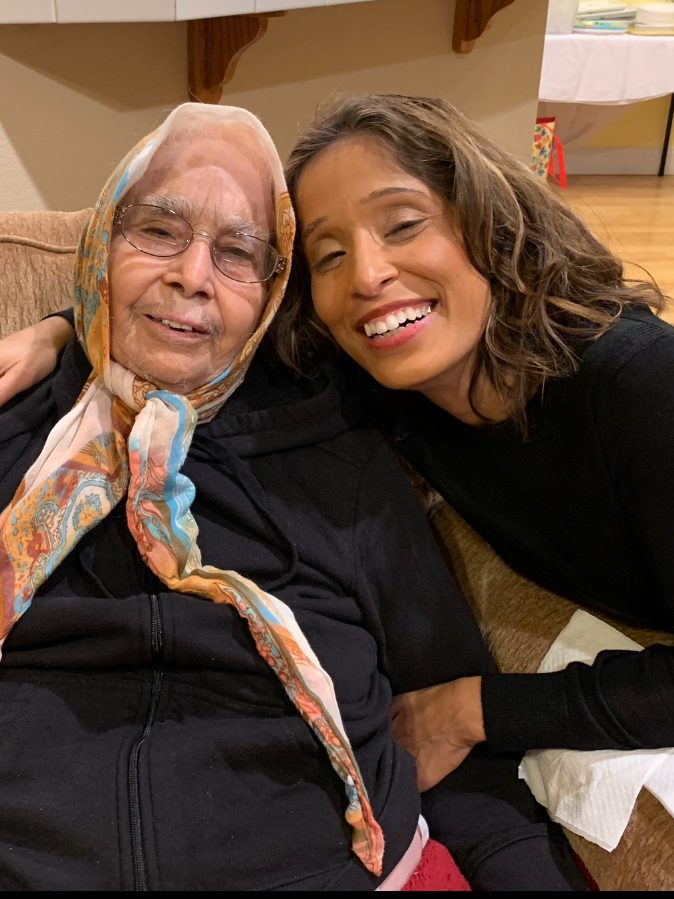
Thanksgiving 2018.
Once upon a time ago, my mother’s home was boisterously overpopulated. Kids were doubled up in beds and hand-me-downs were the fashion. My dad and his brother shared a peach growing business and like other immigrants, our two families also shared a home.
Each family had five kids and The house wasn’t Huge. this meant we all shared the one bathroom in the house. Whenever the family reminisces about growing up in the white-tiled house on Ruth Avenue, the mention of the singular toilet elicits wide-eyed shock and chuckles. Unusual. Perhaps.
Our parents were immigrants and that’s just the way things were done. You waited your turn to poop.
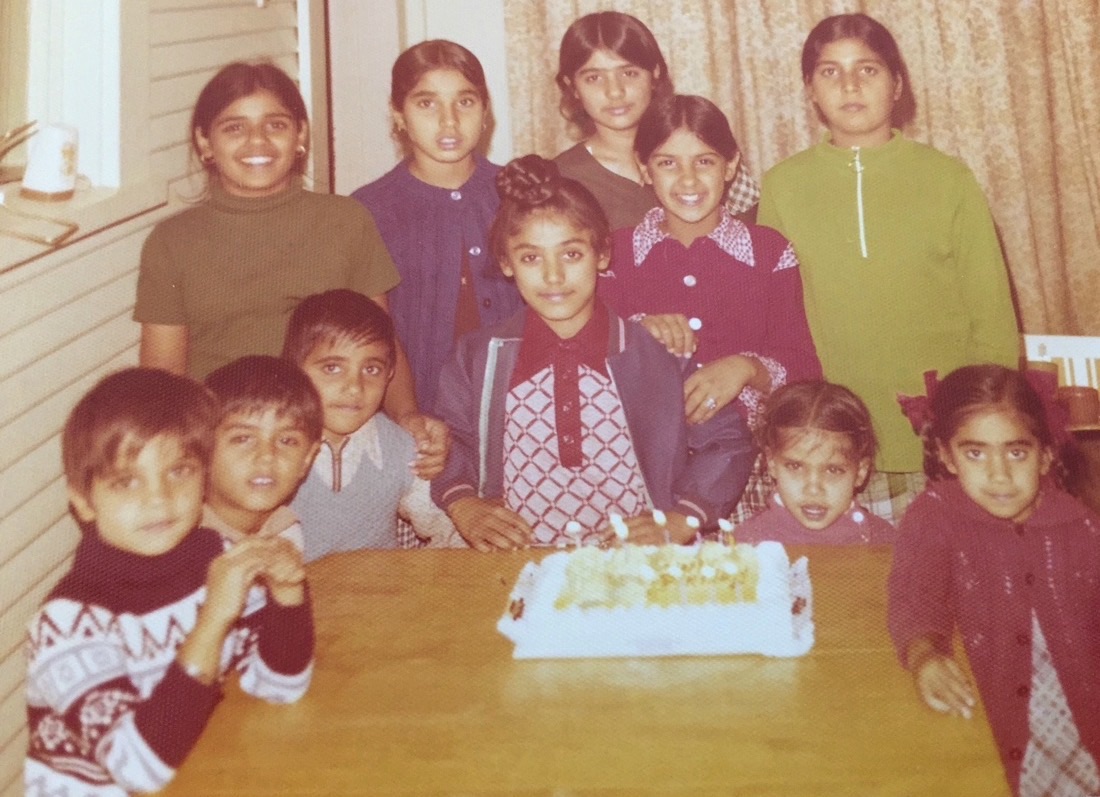
Celebrating a birthday with cousins and a few friends. I’m the sour-faced one.
By the time I arrived on the scene, the last of the ten Purewal cousins born into the compound, my uncle, aunt and their brood had moved to their own home. When I was two, my eldest brother (by 19 years) got married and his wife moved in after she arrived from India. Over the years, their bedroom shrank with the addition of three children. Eventually they too, moved into their own home.
Decades passed and the remaining siblings and I also moved on. Then it was just mom and dad left in the home. As if to mark this Empty Nest transition, the house received a much needed exterior facelift. Out went the white tiles and in came the light blue vinyl, giving the house on an almost middle-class semblance.
Dad passed away ten years ago and since then, my mom has lived alone. When she slowed down, in came the carousel of caregivers rotating in and out.
She still insists on answering her Landline. even though she’s been in the United States 60 years, My mother has never learned to speak English. When she does interface with the outside world, there is always one of us with her to translate.
Even after being in the country nearly 60 years, mom never learned to speak English. She never had any interest. With Five kids who were fluent Speakers, she had no need. She did pick up on the phrases “one minute waitt” and “wrrong numberr” the latter she would holler into the caller’s ear when He or she had INADVERTENTLY dialed My Family’s number. By speaking at a high decibel, mom assumed the caller was more likely to understand her.
If a friend called for me, it was instant mortification. My mom would scream my name as its actually pronounced in Punjabi, “Sukh-jheet.” It was just Too much to have to explain for a teenager who was already insecure.
Before mom decided she was too old, she used to grow a much talked about garden that bloomed from early summer to fall. Bitter melon. Garlic bulbs. Okra. Red onions. Tomatoes.
On the stovetop, mom would transform her produce into works of curry delight. She’d slice open the bitter melons and fill them with a billowy mixture of spice and onions. Each melon was wrapped with twine before mom dropped them into a deep fry bath. We’d sandwich the melons between warm rotis off mom’s griddle.
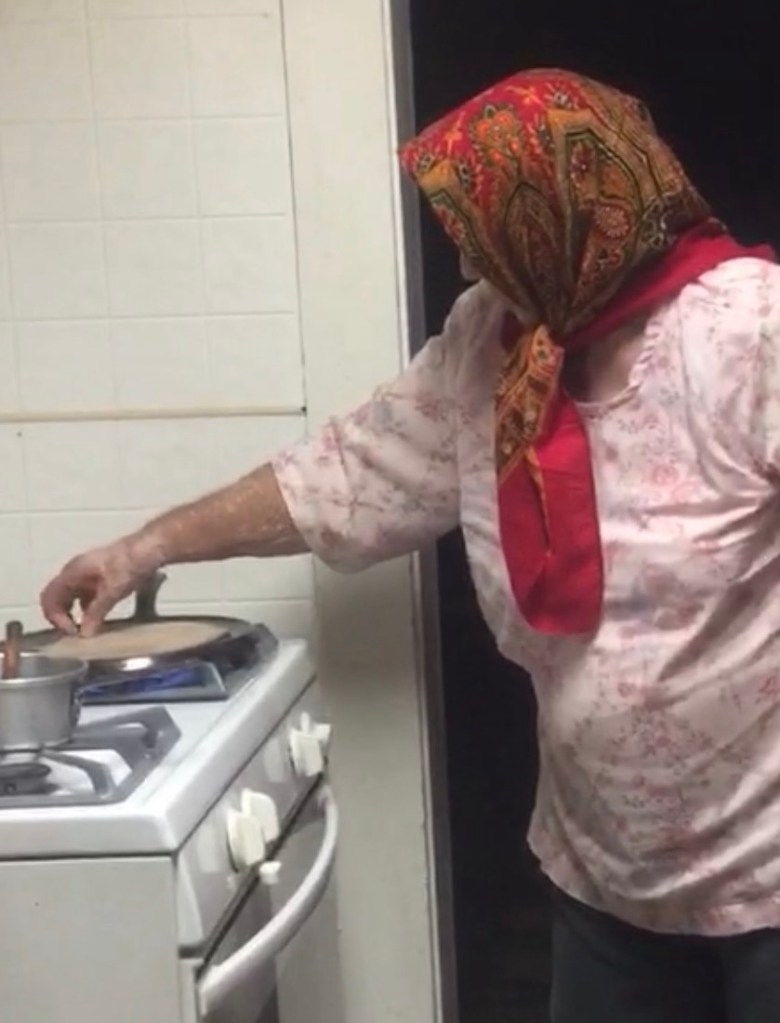
Another day another Roti. December 2017.
winter meant one thing to my mom, Saag. She would pull on a pair of my sister’s old sneakers and ready her containers. dad would have his truck waiting for her as mom never learned to Drive. Mom would direct him out to the family peach orchards to the spots she suspected Spinach and Kale to be Growing wild. Only when she had handpicked as much as she could gather, would they head home.
This was only the first step in an all day process. Mom would wash and chop the leaves. Then the leaves would simmer and boil in mom’s industrial sized pot.
Coming home from school, I’d see the windows of our house fogged over. I knew a a pot of saag was on the stove. Opening the front door, the masala wafted through the air. The unmistakable scent of a punjabi home.
Dinnertime at our house didn’t hold any kind of mystery. Our mom never asked us, “What would you like for dinner?” We never heard phrases like,”I’m making your favorite dish tonight.” We knew it was roti every night. The only question was what sabji or daal we’d be eating.
Nowadays mom spends most of her time in bed or in her recliner, which creaks and leans to one side, as does mom.
When I come over in the late afternoon, I surf through a sea of Indian movies until I find one that seems entertaining.
It’s when I’m alone with my mother that I learn the most about her. IT WAS ON ONE SUCH EVENING THAT I learned the story of my parents’ engagement.
Although my dad was an attractive bachelor, standing over six feet tall and peering out from a set of beautiful green eyes, he was older than my mom. Much Older. If raw calculations are correct, which is all I have to go on since my late father’s age was also unknown, DAd could’ve been 20 years older than Mom. MY GRANDFATHER WASN’T IMPRESSED.
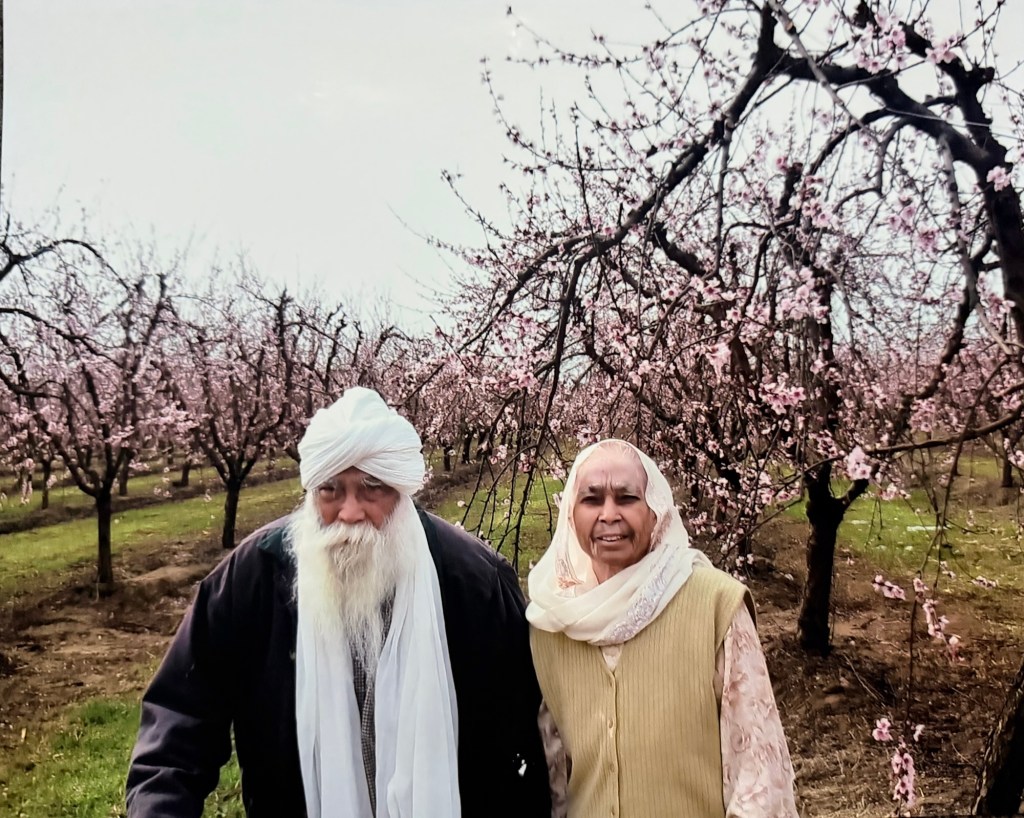
My parents and Spring’s Peach Blossoms. 2010.
In the end, dad got his girl. (Obviously) My grandfather lifted his objections deciding it was better to maintain relations with existing relatives. In truth, His hands were tied as my mom’s older sister was already married to my dad’s cousin.
I also learned about MY MOTHER’S MUKLAwa,
We were watching a movie called Daana Paani, loosely translated as (Food Water) WHICH INCLUDED A wedding between A YOUNG BOY AND A GIRL. my mother explained that such weddings weren’t uncommon IN YEARS PAST. SUCH A CEREMONY WOULD cement a bond BETWEEN TWO SUITABLE FAMILIES BUT THE ACTUAL MARRIAGE WOULDN’T BEGIN UNTIL YEARS LATER WHEN THE CHILDREN HAD GROWN UP.
ONCE THE BRIDE WAS READY TO JOIN HER HUSBAND’S FAMILY (IN KEEPING WITH INDIAN CULTURE) THE HUSBAND, ALONG WITH HIS FAMILY, WOULD ARRIVE TO PICK UP His wife. THE OCCASION WOULD BE MARKED WITH A CELEBRATION KNOWN AS A MUKLAWA.
Curious, I asked my mom if she’d had a muklaWa. Yes, she told me, she did. I NEVER KNEW MY PARENTS HAD BEEN MARRIED FOR TWO YEARS BEFORE MY GRANDPARENTS DECIDED MOM COULD JOIN DAD’S FAMILY.
I press for more. Why two years?
Her responses are the same.
I don’t Know.
that’s just the way things were done.
Stop asking me questions.
I wrote this essay in February 2023. my mother passed away at home in December.
______________________________SP_______________________________
flea market furnished memories
In my second senior year, my roommate and I lived in an apartment that suited our basic needs, two rooms and a kitchen on Ward and Telegraph. The fact that it felt like a 10k walk to campus was an unfortunate side note.
We did have a supermarket around the corner. Of course Adrononico’s was a bit expensive on a College Budget. I would Mentally whittle my shopping list down to the bare essentials As soon as I hit the Produce section. white bread and cellophaneD slices of cheese. Did I really need Mustard?
Safe Location? Hmm. Mostly. Although there was the time the mailman caught the hapless thief crawling through our bathroom window. Imagine the “oh expletive” when he came face-to-face with our treasured second hand furnishings. Exhibit A: our yellow formica table with matching chairs from the Ashby Flea Market.
Overall convenience? A one.
Slouching under the weight of various anthologies, I’d huff along Telegraph wondering why we didn’t live closer to campus. Tuesday and Thursday mornings meant an additional slog along BanCroft Avenue for American Literature at the International House.
Arriving however was nothing short of thrilling. It meant not only seeing my instructor, Professor Breitwieser, but also the Boy. Otherwise catalogued in my memories as the unidentified male.

the unidentified male aka the boy
It’s been years, but I can still picture him. the boy who sat in the desk to my left but who’s name I never learned. TAN. WIRY BUILD. CLOSELY SHORN HAIR.
I can still picture Professor Breitwieser Too, of course it helps the professor is easily found with a quick Google search.
We usually sat in the same two seats, Close to the front of the room, next to each other and never exchanged more than “hi’s”.
I fantasized that one day my Unidentified male would ask me to join him for a cup of coffee after class.
“Hey, want a grab of coffee at Cafe blah . . .?”
Our first date.
The spring semester carried on as Professor Breitwieser continued to enthrall us. Unlike some professors who operated on play mode just regurgitating canned lectures, Breitwieser engaged with the work.
One Morning Breitwieser read from Whitman’s “O Captain, My Captain” Or or was it from Allen Ginsburg’s “Howl”?
Hmm.
Our final exam was in one of the cavernous Wheeler lecture halls. I wondered if the object of my lust was in the room. Short of wandering through each row of desks, I could only wonder if the Unidentified Male had made it in on time.
After finishing, I walked out into the cool early December evening. I wondered if The Boy had finished early and left while I was still madly scribbling my essay responses. Taking a chance that I hadn’t missed him, I I casually hung around. (Imagine feigning casualness with chattering teeth.)
I was rewarded. Sort of.
At some point a door swung open and out he walked shouldering his backpack.
I’d love to end this essay by telling you we finally talked or that he finally asked me to that cup of coffee.
Nah.
Never happened.
In fact, I’m not sure what we said to each other. Maybe it was just our usual “hi’s” or maybe I managed a “that wasn’t too bad” kind of witty banter. Whatever it was, I don’t remember.
While I still had another semester to enjoy with Professor Breitwieser and to consider the lives and works of F. Scott and Zelda Fitzgerald, I never saw the Unidentified Male again.
Off he walked into the cold Berkeley night, having shaped another episode of my college years.
With time I grew more confident as a woman and allowed myself to be less inhibited. I just wish it hadn’t taken so long.
__________________________________SP________________________________
summer vacations
As with most kids, summer vacations were etched on my siblings and my mental calendars as long sun-filled days when we didn’t have to bother with school.
Once released, my older sister, brother and me would perch ourselves in front of the television, watching our favorite 1970s families: The Brady. Bunch and The Partridge Family.
We were mesmerized when the Bradys explored the Grand Canyon, horrified when Bobby and Cindy got lost, envious when they went to Hawaii where the Brady girls and even the housekeeper, Alice, took hula lessons on the beach.
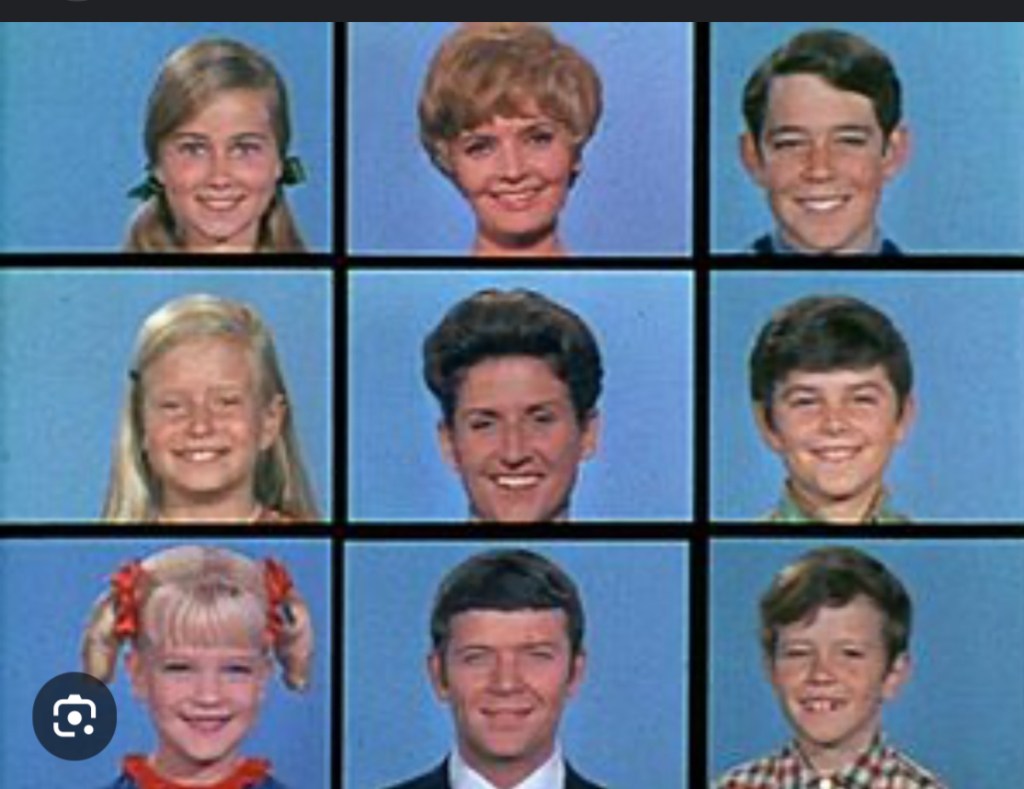
We’d heard rumors that like the Bradys, real life families went on real life vacations, traveling to to exciting places and staying in magical places called hotels.
I say rumors because to me and my siblings, such adventures were as mysterious as the Tooth fairy and Santa Claus, neither of whom ever dropped by our house.
Disneyland. Was that even a real place?
We had no way of knowing.

Me and My siblings.
Our plight was predictable. After all we were born to a pair of Indian immigrants afflicted by an invisible disability known as Fun Gene deficiency Syndrome, or FGDS. Apparently it was endemic in the villages my mom and dad grew up in.
They did their best but as their children, we did suffer.
Sometimes my brother and I would say things like “there’s nothing fun to do” or we would beg for a pool because our neighbors had one. With our noses wedged into the fences’s boards, we’d spy shamelessly on the three Whitney daughters as they laughed and splashed in their pool.
Our boredom would be short-lived. Come July, we’d be too tired to complain. That’s when the family business, peaches, was at its busiest with harvesting.
My dad and his brother had found the American Dream below their feet, in dirt. They worked, saved and bought peach orchards. Eventually they enjoyed a measure of prosperity.
Not that they acted rich. Not with us anyway.
After all, they used us as a source of cheap labor.
We were woken up at 5 a.m. (as if it was no big deal for a fifth-grader on a summer morning) and out in a peach orchard until at least one in the afternoon.
We’d slurp down our cups of tea (we’re Indian, my mom had us hooked at a young age) and climb into my dad’s noisy GMC truck. Oh and if he was in a particular hurry to get to the orchard, our usually mild-mannered father would holler at us to put our shoes on in the truck.
Our jobs weren’t complicated, We were graders. We just threw out peaches that were gunky, too small or just not right to be used for canning and sold in supermarkets.
We collected the reject peaches from bins, large wooden boxes that were being filled by peach pickers.
The peach pickers wore cumbersome bags around their necks in which they dropped the peaches they picked. They would empty their bags into the bins. Using ladders, the peach pickers would climb to the tree tops to make sure they’d picked the trees clean.
It exhausting just to think about.
Our family’s employees were mostly uneducated, doing work that others couldn’t and wouldn’t do. Many of them traveled north from Mexico in their battered Monte Carlos and Impalas. Others were new arrivals from India, realizing that ‘Amrika’ wasn’t as glamorous or as easy as they’d told.
Just like those parents, our own parents were illiterate immigrants who had worked and saved, sacrificing convenience to lay aside a little extra each month.
Understanding how difficult our workers labored and how difficult their lives were, my mom and dad always showed them tremendous kindness and respect. My dad would even skip his lunch so that an employee who needed it more would have something to eat. It was the closest my dad ever came to a diet plan. Dad always packed extra water for employees, years before labor laws required employers to do so.
Eventually the harvest came to an end as did our annual captivity.
School returned. Sadly, we’d trudge back, feeling cheated without having anything interesting to share about our summer breaks. Like outsiders we’d listen to our classmates brag about their summer highlights and all that thy had done and seen.
Sigh.
Only with time and reflection did I appreciate all that my summers had taught me. I saw and learned about the importance of honoring others and their experiences.
Still, I would’ve loved to have been on the beach with my own hula skirt.
____________________________________SP_______________________________
hearts and scars
Growing up, most kids are limited only by their imaginations or however Far their legs will carry them.
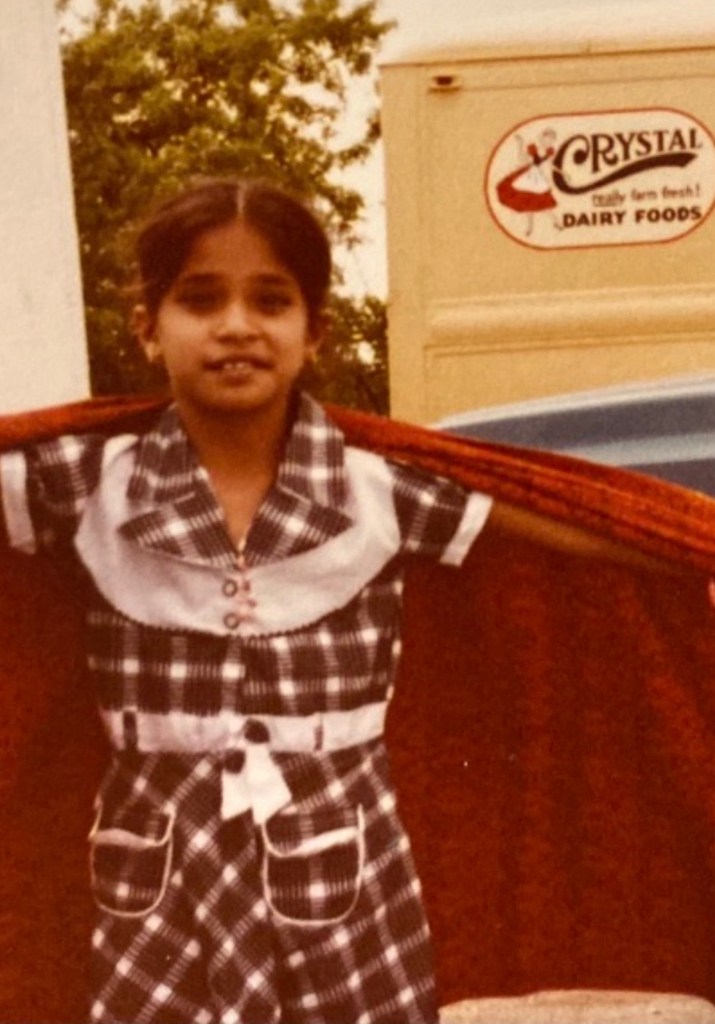
Me doing my best wonder woman imitation. 1979.
Running wild wasn’t in my own DnA. I was limited by my own existence.
Born with heart from the discount aisle of human organs, otherwise known as a congenital Birth defect, Simply walking was too much if there were too many steps involved. Temper tantrums would leave me on the edge of collapse all the while gasping for air.
Not that I remember any of this. My mother however always took the opportunity to remind me of all the trouble she had in raising me. As if I was consulted about the potential health complications of being born to a 40-year-old mother in the 1970s.
Somewhere between the four chambers of my heart, there was a malfunction and the puzzle pieces didn’t line up as they were supposed to. Instead of having deoxygenated blood routed to my lungs and having the oxygenated blood flowing through my body, my organs operated on polluted blood.
think of a car engine running on the same oil forever and ever. In my case the condition came with the fancy name: tetralogy of fallot.